
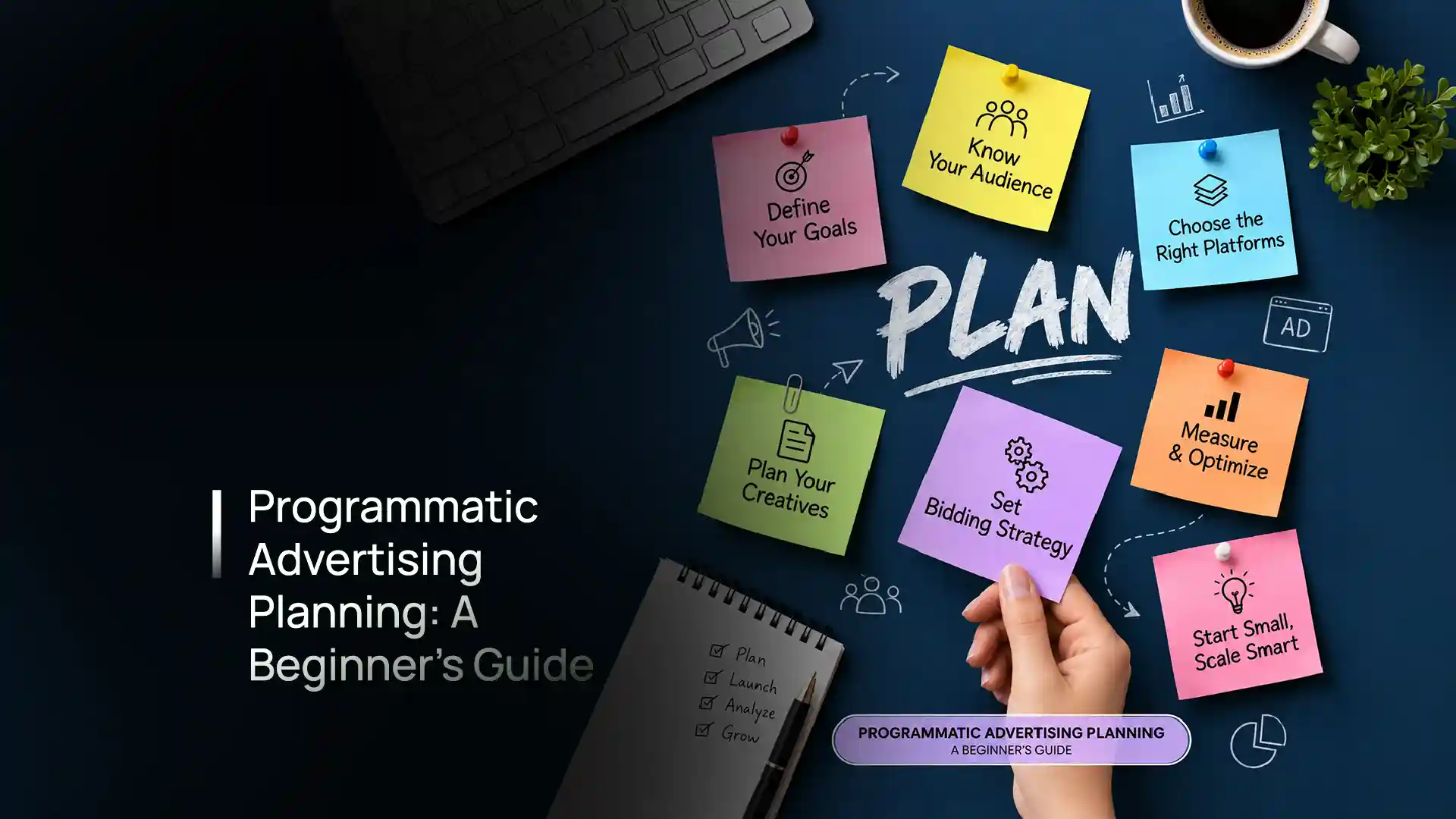

Programmatic advertising planning is the process of using data, audience insights, automated buying technology, creative assets, budgets and measurement goals to plan and purchase digital ad inventory. A strong plan helps businesses reach relevant audiences across display, video, connected TV, audio and other channels while continuously optimising performance.
Here’s the most important thing for beginners: this is not simply “automated advertising.” The technology can automate buying and bidding, but humans still define the strategy, data inputs, creative direction, budget structure and measurement framework. A solid plan answers six core questions — what business objective are we chasing, who is the audience, where should ads appear, what’s the budget, which creative formats and messages, and how will performance be measured and optimised? Get those right and automation scales what works; get them wrong and it just makes poor decisions faster. This programmatic advertising guide walks through each step.

01
Programmatic advertising planning is the strategic preparation that happens before and during automated programmatic media buying. Rather than manually negotiating and placing every ad, advertisers use technology platforms to purchase suitable ad impressions based on defined campaign parameters. It has become a major part of the digital ad ecosystem: according to the IAB/PwC Internet Advertising Revenue Report, programmatic revenue reached $162.4 billion in the US in 2025, representing 20.5% year-over-year growth. The technology automates buying and bidding — but the programmatic advertising strategy behind it is still human.
02
Without a plan, automation can simply make poor decisions happen faster. Platforms evaluate inventory and bidding opportunities at scale, but they still depend on the instructions and signals the advertiser provides — unclear objectives, weak audience definitions, poor creative or inaccurate conversion tracking won’t fix themselves just because automated bidding is available.
The programmatic advertising benefits are clear: effective planning aligns media with business goals, defines relevant audience segments, chooses suitable channels and inventory, prevents budget waste, sets realistic KPIs, improves brand-safety controls, and builds a framework for testing, optimisation and accurate measurement. Modern enterprise platforms such as Google Display & Video 360 bring campaign management, audience data, inventory, creative workflows, measurement and optimisation into one integrated environment, supporting open exchanges, direct deals and guaranteed arrangements.
03
At a simplified level, the process flows: Advertiser → Demand-Side Platform (DSP) → Ad Exchange / Marketplace → Publisher Inventory → User. When a potential impression becomes available, the buying technology evaluates whether it matches the campaign settings and decides whether to bid:
- Signals evaluated: audience characteristics, context and content category, device, location, time of day and available inventory.
- Controls applied: bid price, frequency caps, brand-safety requirements and the predicted likelihood of achieving the objective.
- Not always an open auction: buyers can also use negotiated or guaranteed inventory — Google describes Programmatic Guaranteed as automating direct publisher buys with advanced targeting and consolidated reporting.

04
The first two steps shape every decision that follows:
- Define a clear objective — awareness, traffic, lead generation, consideration, e-commerce sales, app installs, retention or remarketing. An awareness push prioritises reach, viewable impressions and video completion; a lead campaign prioritises qualified leads, cost per lead and conversion rate.
- Define the target audience — start simple (“who benefits most?”), then use signals like location, interests, contextual relevance, first-party data, website engagement, previous conversions and lookalikes.
A common beginner mistake is creating too many narrow segments before the campaign has enough data. Start manageable — existing customers, website visitors, high-intent prospects, broader prospecting and contextually relevant audiences — so you can compare which signals genuinely drive results. Privacy changes also make first-party data and contextual strategies increasingly important, with Google emphasising privacy-focused, multisignal approaches over cross-site identifiers.
05
A budget should follow campaign goals, not an arbitrary spending amount. A useful process: Business Goal → Expected Conversion Volume → Estimated CPA → Required Budget — for example, desired qualified leads × acceptable cost per qualified lead = estimated media budget.
The final figure should also account for testing, creative production, platform and technology costs, data costs, optimisation periods and measurement infrastructure. Avoid major decisions based on the first few days of data — campaigns often need enough volume to reveal meaningful patterns — and let allocation reflect the customer journey, since running only conversion ads can miss future customers still in awareness or consideration. Connect this with Thinkster’s digital marketing, performance marketing and PPC resources for an integrated paid-media approach.
06
In programmatic vs traditional advertising, the distinction isn’t absolute — the technology can also power direct and guaranteed deals — but the core differences are clear:
| Factor | Programmatic | Traditional Direct |
|---|---|---|
| Buying process | Technology-assisted & automated | Often manually negotiated |
| Optimisation | Continuous, data-driven | More manual adjustments |
| Targeting | Multiple audience & contextual signals | Mostly publication or placement |
| Inventory access | Exchanges & multiple sources | Direct from specific publishers |
| Scale | High | Limited by manual processes |
| Reporting | Often consolidated in platforms | Varies between publishers |
| Best use | Scalable, data-informed campaigns | Premium publisher relationships |
07
Programmatic ad formats should support the objective — don’t pick one just because it’s available. Start with the customer journey and message:
Display
Programmatic display advertising for awareness, remarketing, product promotion and broad reach.
Video
Brand storytelling, product demonstrations, awareness and consideration.
Connected TV
Large-screen video, brand campaigns and audience-based TV advertising.
Audio
Streaming audiences, awareness and screen-free moments.
Native
Less disruptive, content-driven and contextually relevant experiences.
08
Programmatic buying strategies span several transaction approaches — the right one depends on your need for scale, control, premium inventory, predictability and flexibility:
| Buying Model | What It Is | Best For |
|---|---|---|
| Open Marketplace | Inventory via broad exchanges | Reach & scalable prospecting |
| Private Marketplace (PMP) | Select buyers, specific inventory | Control & premium environments |
| Preferred Deals | Priority access, not all impressions guaranteed | Priority to relevant inventory |
| Programmatic Guaranteed | Agreed inventory & price, automated execution | Premium inventory with certainty |
Leading demand-side platforms such as The Trade Desk and Google’s DV360 support these models across formats and channels.

09
Plan measurement before launch, across three levels:
| Level | Purpose | Examples |
|---|---|---|
| Primary KPI | The most important outcome | Qualified leads, revenue, purchases, CPA |
| Secondary KPIs | Explain performance | Reach, frequency, CTR, viewability, conversion rate, VCR |
| Diagnostic | Identify problems | Placement, audience, device, creative, geo performance |
The framework should connect advertising activity with real business outcomes wherever possible — generating 1,000 leads cheaply isn’t success if only a small percentage become qualified prospects. Thinkster’s guides on ROI in digital marketing and click-through rate help build a broader measurement framework for paid campaigns.
10
A few data points worth knowing: US programmatic revenue hit $162.4 billion in 2025 (IAB/PwC, +20.5% YoY); IAB’s 2026 outlook forecasts 9.5% growth in US ad spend, with AI increasingly central to planning; and IAB’s 2025 State of Data research found only 30% of agencies, brands and publishers had fully integrated AI across the media campaign lifecycle. The takeaway: planning is becoming more strategic as automation expands, not less. Avoid these common mistakes:
- Starting without conversion tracking, or using too many audience segments to gather useful data
- Optimising only for CTR, or ignoring creative testing — automation can’t fix a weak message
- Forgetting frequency controls, or chasing only cheap impressions (cheap isn’t valuable)
- Ignoring brand safety and inventory quality, or making optimisation decisions too early
11
Programmatic advertising for beginners works best as a simple, beginner-friendly framework, start to finish:
- Goal → Audience: define the business goal (e.g. qualified B2B leads), then the audience (decision-makers, website visitors, relevant publishers).
- Funnel stage → Formats: pick awareness, consideration, conversion or retention, then match formats (video for awareness, display for consideration, remarketing for conversion).
- Budget & test structure → Measurement: allocate enough to compare audiences, creative and inventory, then configure conversion and lead-quality tracking.
- Launch & monitor → Optimise: review delivery, audience quality, creative and conversions, then scale effective combinations and cut inefficient spend.
12
AI will make planning increasingly automated — in audience development, media forecasting, bid optimisation, creative variation, performance analysis and budget allocation. But it doesn’t remove the need for strategy: IAB’s State of Data research notes AI can support the whole campaign lifecycle, yet organisations still need strategic roadmaps, governance, quality data and measurement systems to use it well.
The marketer’s role increasingly becomes deciding what automation should optimise for, rather than manually controlling every buying decision. So the smartest approach isn’t “let the algorithm do everything” — it’s set the right objective, provide useful signals, measure meaningful outcomes, then continuously improve. For an integrated growth strategy, programmatic planning should work alongside SEO, content, performance campaigns, conversion optimisation and a strong website — exactly how Thinkster connects digital marketing services and SEO into one accountable system.
The best programmatic strategy isn’t “let the algorithm do everything.” Set the objective, provide the signals, measure the outcomes — then improve.
Frequently Asked Questions
It’s the process of defining campaign goals, audiences, budgets, inventory, creative formats, buying strategies and measurement systems before using automated technology to purchase digital advertising.
Yes. Beginners can start with a simple structure, clear KPIs, limited audience segments, reliable conversion tracking and a testing plan. The technology can be complex, but the underlying marketing principles stay straightforward.
PPC is a payment model where advertisers typically pay per click. Programmatic refers to technology-driven media buying and can support different objectives and pricing models, including impression-based buying.
A demand-side platform (DSP) is technology used by advertisers and agencies to purchase and manage digital advertising inventory across multiple sources.
Costs vary with inventory, audience competition, geographic targeting, media format, campaign scale, technology fees and data requirements. Evaluate total campaign costs, not just media spend.
Common approaches include open marketplace buying, private marketplaces (PMP), preferred deals and programmatic guaranteed arrangements.
Plan the Strategy,
Let Automation Scale It
Thinkster plans objectives, audiences, creative and measurement first — then uses programmatic automation to scale what actually drives leads and revenue.


