
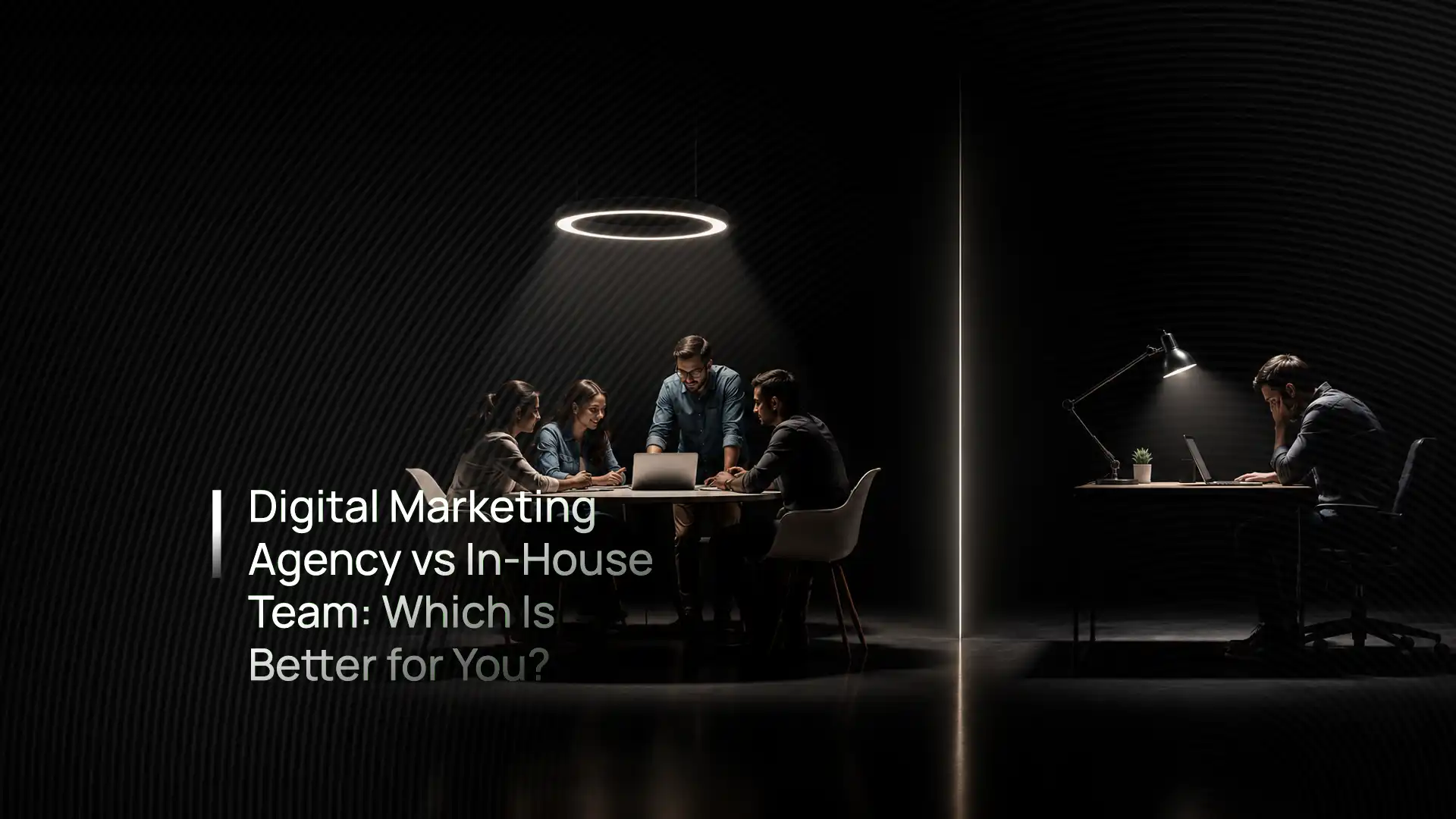

Choosing between a digital marketing agency vs in-house team depends on your budget, growth stage, expertise needs and how much control you want. An in-house team offers deeper brand ownership; an agency offers broader specialist expertise, faster scalability and flexible costs — and for many growing businesses, a hybrid marketing model delivers the best of both.
Marketing used to be simpler — a website, some social posts, a few ads, done. Now SEO, Google Ads, Meta and your analytics dashboard all have opinions, and AI has entered the group chat. So businesses face a practical question: build your own marketing team, or work with an external agency? There’s no universal winner — the right choice depends on what you’re trying to achieve, how fast you need results, and whether you need one marketing skill or an entire ecosystem.
And the numbers show why it matters: Gartner’s 2026 CMO Spend Survey found marketing budgets essentially flat while marketers allocate an average of 15.3% of budgets to AI, yet only 30% feel mature enough to scale it. Marketing is getting more complicated while budgets aren’t multiplying — so let’s break down the agency vs in-house debate without the corporate fog.

01
An in-house marketing team is made up of employees who work directly for your company — a marketing manager, SEO specialist, social media manager, content writer, designer, PPC specialist or analyst. A digital marketing agency is an external team hired to run some or all of your marketing: SEO, paid ads, social, content, web development, branding and analytics. The fundamental difference is simple: in-house gives you dedicated internal ownership, while an agency gives you access to external expertise and infrastructure — the heart of the in-house vs agency marketing debate.
Think of it like cooking — an in-house team is building your own kitchen (hire the chef, buy the equipment, run it), while an agency is a professional kitchen you tap into when you want the meal without owning the restaurant. Neither is automatically better; the question is what you’re hungry for.
02
Here’s the classic mistake: comparing an agency’s monthly fee with one employee’s salary. That’s not apples-to-apples. An employee’s true marketing agency cost comparison must include recruitment, benefits, training, software, marketing platforms, management time, equipment, leave and replacement costs when someone leaves. And one person rarely covers every discipline — hiring an SEO executive doesn’t hand you PPC, social, design, web development, analytics and content strategy too. You may eventually need several specialists, while an agency packages access to multiple skill sets into one relationship:
| Factor | In-House Team | Digital Marketing Agency |
|---|---|---|
| Recruitment | Your responsibility | Agency handles staffing |
| Specialist expertise | Requires multiple hires | Available across disciplines |
| Fixed payroll | Higher | Usually lower / flexible |
| Software costs | Your responsibility | Often included |
| Scalability | Requires hiring | Usually easier to scale |
| Brand knowledge | Very high | Builds over time |
| Daily control | Very high | Moderate |
| Replacement risk | Your responsibility | Agency manages continuity |
That doesn’t mean an agency is always cheaper. For a large company with substantial, ongoing needs, an internal department can eventually make financial sense — but for smaller or growing businesses, assembling a complete specialist team can quickly exceed the apparent cost of outsourcing marketing.

03
The biggest advantage is proximity — your internal team lives inside the business, hears sales calls, sits in strategy meetings and knows the brand’s personality:
Deeper Brand Knowledge
Intimate understanding of customers, products, brand voice, sales objections, culture and priorities.
Faster Communication
Need a campaign changed? Walk over to the manager. Everyone’s in the same Slack channel.
Greater Control
Direct control over priorities, workflows, hiring, processes and campaign decisions.
Institutional Knowledge
Over time the team builds a library of what works — and that knowledge stays inside the company.
Dedicated Attention
An employee is hired for your company alone, while an agency manages multiple clients.
04
Building a team is easy; building a great team is not. Digital marketing isn’t one job anymore:
- You may need specialists for SEO, paid media, content, social, design, dev, analytics, email and automation — hiring all of them is expensive
- Talent gaps: you might land a strong PPC specialist but struggle to find an equally strong SEO pro, designer and strategist
- Excellent individuals don’t automatically operate as one connected system
- Skill stagnation: an internal marketer sees less of what’s happening across other industries and platforms
05
An agency’s biggest advantage is breadth — instead of hiring one person at a time, you gain a team with different skill sets connected to the same growth objective. These digital marketing agency benefits matter most when needs change fast. The benefits of a digital marketing agency include:
Multiple Specialists
SEO, paid ads, landing pages and conversion work — different capabilities, one ecosystem.
Faster Scalability
Launches, seasonal campaigns and expansion — scale scope up without recruiting.
Broader Experience
Exposure to many businesses and challenges brings outside perspective into your strategy.
Lower Hiring Risk
Access capabilities without immediately committing to permanent headcount.
External Accountability
A good agency explains what was done, why, what changed and what happens next.
06
Agencies aren’t magical growth vending machines — there are genuine trade-offs:
- Less direct control — you work through an external team, so approvals and scopes matter
- Brand learning curve — an agency doesn’t know your business on day one (good onboarding shortens it)
- Quality varies — some agencies are strategic partners, some are task factories; judge process and track record
- Multiple clients — you won’t get 100% of their attention, so communication expectations matter
07
Often, yes — especially when the business needs several capabilities but isn’t ready to build a full department. A growing company might need SEO, paid advertising, social, content, web development and analytics at once; hiring one person per function creates a heavy fixed cost, while a digital marketing agency for small business provides access to those capabilities without building every function internally.
This matters most when budgets are under pressure: Gartner’s 2025 CMO Spend Survey found marketing budgets flatlined at 7.7% of company revenue, with 39% of CMOs planning to cut agency budgets and 22% saying GenAI had reduced reliance on external agencies. That sounds like bad news — but the smarter reading is that businesses aren’t asking whether to outsource everything anymore; they’re asking which capabilities to own and which to access.
08
Deciding when to build in-house marketing team strength — or hire out — usually comes down to involvement, scale and management capacity:
| Build In-House When… | Hire an Agency When… |
|---|---|
| Marketing decisions happen every hour | You need specialist skills quickly |
| Your operation is large and ongoing | Your team is small or you’re entering a new market |
| Your product needs deep, immersed expertise | You need multiple channels without managing many hires |
| You have strong management to lead marketers | Requirements fluctuate or you want outside perspective |
Remember: hiring five marketers doesn’t create a strategy. Someone still has to set goals, KPIs, processes, budgets and accountability — and if you can’t, managing an agency may actually be simpler. Knowing when to hire a marketing agency often starts with an honest look at your own management capacity.
09
Absolutely — and the hybrid marketing model is often the smartest option for growing companies. Instead of treating a marketing agency vs in-house team as opposing sides, assign them different responsibilities:
| Function | In-House | Agency |
|---|---|---|
| Brand direction | ✓ Owns | Support |
| Customer insights | ✓ Owns | Support |
| Marketing leadership | ✓ Owns | Support |
| SEO & PPC execution | — | ✓ |
| Website development | — | ✓ |
| Creative & social | ✓ | ✓ |
| Analytics & strategy | ✓ | ✓ |
Picture a company with one marketing manager who owns the brand, pipeline and goals. Instead of hiring six more people, it partners externally for SEO, PPC, website optimisation, creative and campaign execution. The manager stays the strategic owner; the external team becomes an extension of the department. That’s not “outsourcing marketing” — it’s augmenting the team.

10
Skip “should we hire an agency?” and work through these instead:
- What skills do you actually need? List the missing capabilities first
- How much work is there? One audit a quarter vs weekly execution changes the maths
- How quickly do you need results? An established agency can start faster
- How much management capacity do you have? Teams don’t manage themselves
- What should stay close? Strategy and brand in-house; specialist execution can be outsourced
11
The old agency-versus-in-house debate is shifting because AI is changing the economics of marketing. Gartner’s 2026 research found CMOs allocate 15.3% of budgets to AI while 70% call becoming an AI leader critical — yet only 30% have mature readiness. Its 2025 data showed digital channels at 61.1% of total marketing spend.
So your team doesn’t just need people who can “post on Instagram” — it needs data, automation, AI, search, paid media, creative, conversion and analytics skills, which makes specialisation increasingly valuable. If you choose an agency, don’t disappear after signing:
- Clear objectives — “40 qualified leads a month at an acceptable cost,” not “more traffic”
- Defined KPIs — leads, revenue, conversion rate, CAC, ROAS, organic traffic, cost per lead
- Strong onboarding & regular communication — a consistent system, not a 90-minute weekly meeting
- Shared accountability — measure performance (leads, conversions), not just activity (“32 posts”)
Look beyond the pitch deck: a good partner explains how marketing connects to business outcomes with strategic thinking, transparent reporting, specialist expertise and a willingness to challenge bad ideas. At Thinkster, the approach connects strategy, execution, websites, SEO and performance rather than treating each channel as a separate island — explore Thinkster’s broader digital marketing services to see how the pieces fit.
12
Neither wins by default — the in-house marketing vs agency answer always depends on your situation. Choose in-house when deep business knowledge, constant involvement, control and long-term internal capability matter most. Choose an agency when you need multiple specialists, faster execution, flexibility and external expertise without building a large department. Choose hybrid when you want strategic ownership internally but specialist firepower externally — for many growing businesses, that’s the sweet spot. You don’t have to choose between “our team” and “their team”: build one growth system, let your internal team own the business, let specialists handle the specialist stuff, and make everyone answer the same question — did this actually move the business forward?
You don’t need “our team” versus “their team.” Build one growth system and make everyone answer to results.
Frequently Asked Questions
It depends on scope. A single employee may cost less than an agency, but a complete in-house department gets significantly more expensive once salaries, benefits, software, recruitment and training are included. Agencies are often more cost-efficient when you need several specialist skills without full-time hires for every function.
Not necessarily. In-house teams usually offer deeper brand knowledge and more day-to-day control, while agencies provide broader specialist expertise and scalability. The better option depends on company size, marketing complexity, budget, internal leadership and growth goals.
A startup may benefit from an agency when it needs several marketing capabilities but doesn’t yet have the budget or workload to justify multiple full-time hires. An agency can also help test channels before deciding which capabilities to build internally.
Yes — this hybrid model works particularly well. An internal marketer can own strategy, customer insights and coordination while an agency provides specialist capabilities such as SEO, paid advertising, design, development or analytics.
The main ones are less direct control, an initial learning curve, communication requirements and the fact that the agency works with multiple clients. These risks can be reduced through clear scopes, KPIs, reporting systems, communication processes and strong onboarding.
Agency, In-House or Hybrid —
Let’s Build the Right One
Thinkster works as your marketing team or an extension of it — strategy, websites, SEO, paid media and performance connected to one growth objective.


