
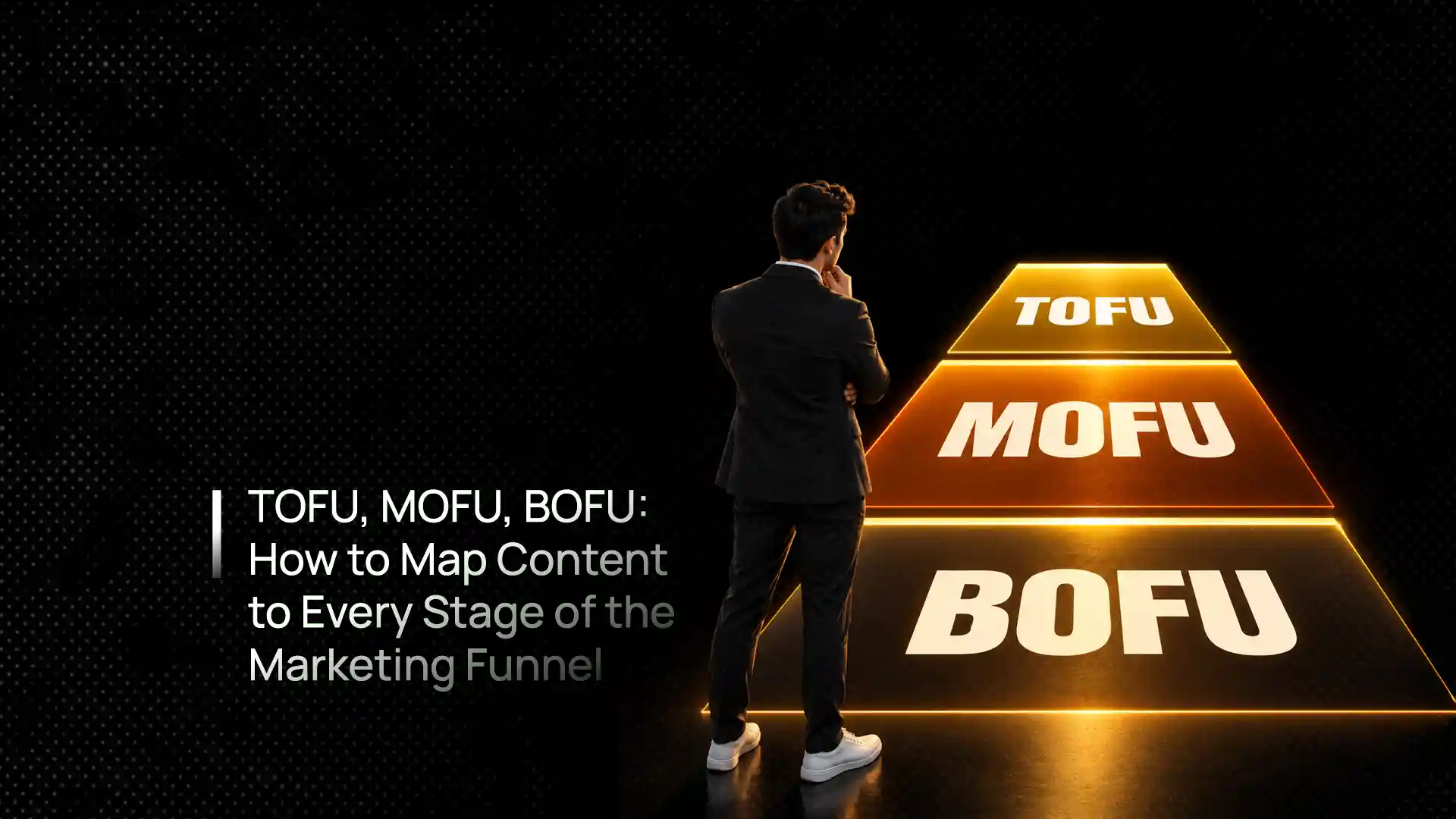

TOFU MOFU BOFU content should be mapped to the audience’s level of awareness and buying intent — not published as a random mix of blogs, ads and sales pages. TOFU attracts and educates, MOFU builds trust and helps prospects evaluate options, and BOFU removes final objections and drives conversion.
A strong content funnel gives every piece of content a job. Instead of asking “what should we post this week?”, marketers can ask “what does our audience need to know before taking the next step?” That distinction matters. Google and Bain research found that 92% of B2B buyers already have a shortlist of preferred vendors before they actively begin the buying process — so brands need visibility and trust well before the final comparison stage. This guide shows how to map marketing funnel content to every stage.

01
Top-of-funnel, Middle-of-funnel and BOFU represent three broad marketing funnel stages — the framework matches content format, messaging, keywords and calls to action with what a prospect is actually trying to accomplish:
TOFU — Top of Funnel
Awareness and discovery. The visitor thinks “I have a problem or question” and wants to learn.
MOFU — Middle of Funnel
Consideration and evaluation. “I understand the problem and am exploring solutions” — they want confidence.
BOFU — Bottom of Funnel
Decision and conversion. “I am ready to choose” — they want proof and an easy next step.
A first-time visitor searching “how does SEO work?” needs something very different from a prospect searching “SEO agency vs in-house SEO team.” Treating both the same is one of the fastest ways to create content that gets traffic but produces few qualified leads. The simple principle: low awareness = educate; growing awareness = guide and build confidence; high purchase intent = help the prospect choose and act.
02
Each stage serves a different mindset, goal and content type:
| Stage | Audience Mindset | Primary Goal | Typical Content |
|---|---|---|---|
| TOFU | “I have a problem or question” | Create awareness | Blogs, guides, videos, social posts |
| MOFU | “I’m exploring solutions” | Build trust & consideration | Case studies, webinars, comparisons, email |
| BOFU | “I’m ready to choose” | Drive conversion | Service pages, demos, testimonials, proposals |

The biggest mistake is assuming the funnel is a strict, one-way journey. Modern buyers jump between stages — they might discover a brand through a short video, read a guide, visit a case study, leave, return through a branded search and contact you weeks later. The purpose of mapping isn’t to force everyone into a straight line; it’s to ensure useful content exists for every important moment of evaluation.
03
Top of funnel content targets people researching a topic, problem or question — they may not know your brand or even which solution they need. These are primarily informational searches (“why is my website getting traffic but no leads?”, “how does local SEO work?”, “what is performance marketing?”). Good top-of-funnel content should answer an important question, demonstrate expertise, create brand discovery, earn organic visibility and give a logical next step — it should not immediately scream “buy now.” Effective formats include educational blog posts, beginner guides, checklists, industry explainers, infographics, short-form video, research and “how-to” articles.
For example, a digital agency could publish “What Is SEO and How Does It Work?”, educating readers first, then linking to a detailed guide, case studies or a service page. HubSpot’s research highlights that website, blog and SEO activity rank among the strongest ROI-driving channels for B2B marketers. On CTAs, avoid forcing a consultation on every article — use low-friction options instead:
- Read the complete guide · Download the checklist · Explore related strategies
- Learn how the process works · See real examples · Subscribe for more insights
04
Middle of funnel content targets prospects who understand their problem and are now evaluating solutions — they’re no longer looking only for information, but for confidence. Middle-of-funnel content should answer questions like “which solution is right for me?”, “should we hire an agency or build a team?”, “what should this service include?” and “what results are realistic?” Useful formats include case studies, comparison articles, webinars, detailed guides, email nurture sequences, industry reports, templates, calculators and frameworks. Content Marketing Institute’s B2B research shows successful teams focus on delivering relevant content to the right audience at the right time.
Take someone searching “SEO agency vs in-house SEO team” — already comparing approaches. A useful comparison article could explain cost, expertise, tools, speed, scalability and when each option makes more sense. The best outcome isn’t to force the conclusion that your service is always the answer — a transparent comparison builds credibility, and credibility moves prospects toward the decision stage. For Thinkster, this content naturally connects readers with relevant pages across SEO, website development, branding and social media.
05
Bottom of funnel content is for prospects close to deciding — high commercial intent, searching for services, comparisons, pricing, reviews and consultations. At this stage they want proof you’re the right choice.
Effective bottom-of-funnel content includes service pages, case studies, testimonials, portfolio pages, pricing or investment guides, consultation pages, comparisons and detailed process pages. A decision-stage page should make it easy to answer: what exactly do you offer, who is it for, what’s your process, why should I trust you, what makes you different, what outcomes can I expect, and what happens next? A vague page can lose a buyer who was otherwise ready to convert. Match the CTA to the commitment level:
- Book a consultation · Request a proposal · Get a quote
- Start your project · Schedule a discovery call · Talk to an expert
06
Here’s how to map content to funnel stages: start with the customer’s questions, not your preferred formats. One customer problem can become an entire content cluster — here are funnel content examples:
- Problem: “our website gets visitors, but they aren’t becoming enquiries.”
- Awareness: why websites get traffic but no leads · common conversion mistakes · how to improve UX.
- Consideration: redesign vs conversion optimisation · what a lead-gen website includes · a conversion checklist.
- Decision: the website design process · a project case study · the website development service page.
Then identify search intent: informational intent is usually top-of-funnel, commercial investigation is middle, and transactional or high-action intent is bottom. But intent isn’t perfect — a business owner researching “how much does a website cost?” may be close to buying even though the query looks informational. So map with search intent + customer context + conversion readiness together.
07
Keywords can be mapped by intent — but don’t create a decision-stage page just by bolting a commercial keyword onto an educational article. Each page should satisfy its dominant intent:
| Stage | Keyword Patterns | Example |
|---|---|---|
| TOFU | what is, how does, why, benefits of, guide to, tips for | “what is conversion rate optimisation?” |
| MOFU | best, vs, comparison, alternatives, cost of, how to choose | “SEO agency vs in-house SEO” |
| BOFU | [service] agency, [brand] reviews, [brand] pricing, hire [service] | “SEO services / SEO consultation” |
Our keyword research tools guide goes deeper on matching intent to pages, and the SEO vs SEM guide shows how organic and paid can cover different intents.
08
Internal linking is one of the most practical ways to turn individual pieces into a connected journey — a top-of-funnel article should never end in a dead end. For example: “What Is SEO?” → “SEO Agency vs In-House SEO: Which Is Better?” → SEO Services.
That creates a logical progression from education to comparison to conversion. On the Thinkster site, relevant links connect educational guides to SEO services, website-performance articles to website design, brand-building articles to branding, social strategy content to social media management, and lead-generation content to digital marketing. The goal isn’t to force a funnel path — it’s to give readers a relevant next step whenever their intent changes.

09
Different formats work at every stage — the format doesn’t automatically determine funnel position. A video can be top-of-funnel education or bottom-of-funnel proof; a blog can be an intro guide or a detailed comparison. Still, this framework helps:
| Content Format | TOFU | MOFU | BOFU |
|---|---|---|---|
| Blog post | High | High | Medium |
| Short video | High | Medium | Medium |
| Case study | Low | High | High |
| Service page | Low | Medium | Very High |
| Comparison page | Low | Very High | High |
| Testimonial | Low | Medium | Very High |
| Pricing guide | Low | High | Very High |
Content Marketing Institute’s research reinforces using multiple formats and channels — email, social, blogs and events — rather than relying on one.
10
Every stage needs different KPIs — judging a top-of-funnel article only by direct enquiries misses its real job:
| Stage | What to Measure |
|---|---|
| TOFU | Organic impressions, rankings, traffic, new users, engagement, video views, subscriptions |
| MOFU | Returning visitors, content downloads, webinar registrations, email engagement, assisted conversions |
| BOFU | Leads, qualified leads, consultation requests, conversion rate, cost per lead, revenue, CAC |
A top-of-funnel piece may simply create the first interaction that eventually leads to a conversion through several other channels. At the same time, traffic without business relevance isn’t success — a funnel should ultimately connect visibility to meaningful commercial outcomes.
11
AI-powered discovery is making content quality, clarity and distinctiveness even more important. HubSpot’s 2026 State of Marketing report emphasises the growing importance of trust, brand point of view and human differentiation as AI increases the volume of content online. For AEO and GEO, content should be easier for search engines and AI systems to understand:
- Answer key questions directly, use descriptive headings, and structure information clearly.
- Include relevant comparisons, support claims with credible sources, and show first-hand expertise.
- Use consistent terminology, add genuinely useful FAQs, and include original insights — not rewritten generic advice.
- Connect related pages through meaningful internal links.
The future isn’t simply producing more content — it’s producing better-connected, more credible and more useful content.
12
Before publishing any piece of content, answer five questions — this prevents the common mistake of creating isolated content:
- Who is this for? Define the specific audience segment.
- What do they already know? Identify their awareness level.
- What question are they answering? Start with the real information need.
- What action comes next, and where do they go after? Choose an intent-appropriate CTA and the next relevant link.
A successful funnel content strategy doesn’t ask every visitor to buy immediately — it recognises that buyers move through different levels of awareness and need different information at different moments. Top-of-funnel gets you discovered, Middle-of-funnel gives people reasons to trust you, and Bottom-of-funnel gives them reasons to choose you. That’s exactly how Thinkster builds content — connecting SEO, content and digital marketing into one full funnel content strategy, so every asset has a job and a next step.
Top-of-funnel gets you discovered. Middle-of-funnel gives people reasons to trust you. Bottom-of-funnel gives them reasons to choose you.
Frequently Asked Questions
TOFU content builds awareness and educates new audiences. MOFU content helps prospects evaluate solutions and build trust. BOFU content supports the final decision and encourages conversion.
No. A blog can serve any funnel stage. A beginner guide may be top-of-funnel, while a detailed comparison or pricing article may be middle- or bottom-of-funnel.
There’s no universal ratio. Most businesses benefit from enough awareness content to generate discovery, enough consideration content to nurture evaluation, and strong decision-stage pages to convert demand.
Yes, but every page should have a clear primary intent. Trying to serve every audience at once can make the content unfocused.
MOFU content bridges the gap between awareness and conversion. It helps prospects evaluate options, understand trade-offs and develop confidence in a solution.
Low-friction CTAs generally work best — reading a related guide, downloading a checklist or exploring a useful resource, rather than an immediate consultation request.
Give Every Piece of Content
a Job in the Funnel
Thinkster maps content to awareness, consideration and decision — connected by internal links and tied to leads and revenue, not just traffic.


